Fort Lauderdale Real Estate Market 2026: Complete Analysis & Outlook
In-depth analysis of the Fort Lauderdale real estate market in 2026. Current home prices, inventory trends, buyer vs. seller dynamics, neighborhood insights, and expert predictions.
 Scott Lehr PA • The Home Owners Listing Team • (954) 342-6180
Fort Lauderdale Real Estate Market 2026: Complete Analysis & Outlook
If you've been watching the Fort Lauderdale real estate market — whether you're a buyer trying to find your moment, a seller wondering whether to list, or an investor sizing up opportunities — 2026 is a year that demands careful attention. The market is doing something genuinely interesting right now: it's neither the frenzied free-for-all of 2021–2022 nor the hesitant pause of 2023. It's something more nuanced, and frankly, more sustainable.
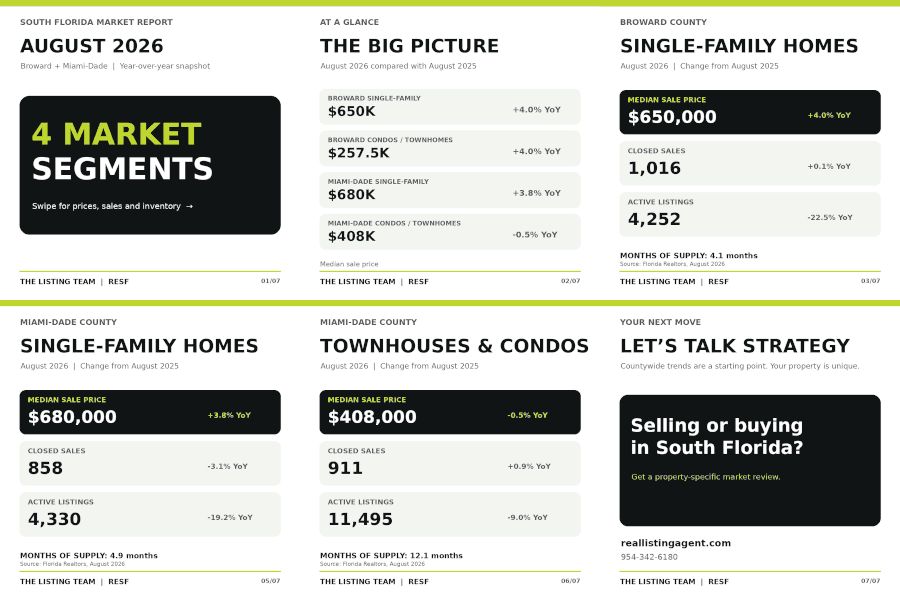
The headline numbers tell part of the story. Median single-family home prices in Fort Lauderdale and Broward County are holding firm around $650,000, up a measured 4% year-over-year. Inventory remains historically tight at roughly 2,100 active listings across the market. Homes that are priced right and well-presented are going under contract in about 30 days. That's not a bubble — that's a well-supported market with real demand drivers behind it.
At The Home Owners Listing Team, led by Scott Lehr, we've been working this market through multiple cycles. What we're seeing on the ground in 2026 is a market that rewards preparation, local knowledge, and strategic thinking — whether you're buying or selling. This analysis is designed to give you exactly that foundation. Let's dig in.
Current Market Snapshot: Fort Lauderdale by the Numbers
Before getting into the dynamics driving this market, here's a clear-eyed look at where things stand as of mid-2026. These figures draw from MLS data, Broward County property records, and our own transaction experience at The Home Owners Listing Team.
| Market Indicator | Current Value | Year-Over-Year Change |
|---|---|---|
| Median Single-Family Home Price | $650,000 | ↑ 4% |
| Median Condo / Townhome Price | $395,000 | ↑ 2% |
| Active Listings (Broward County) | ~2,100 | ↑ 8% (still historically low) |
| Average Days on Market | 30 days | +4 days vs. 2025 |
| List-to-Sale Price Ratio | 97% | Stable |
| New Construction Share of Sales | 12% | ↑ 2 pts |
| Months of Supply | 2.8 months | ↑ 0.4 months |
| Cash Buyer Share | 38% of transactions | Slightly lower than 2025's 41% |
The 2.8 months of supply figure is particularly telling. A balanced market — where neither buyers nor sellers have a structural advantage — typically sits at 5–6 months of supply. At 2.8 months, Fort Lauderdale remains firmly in seller's market territory, though the slight rise from last year suggests the market is normalizing at the margins. That's a healthy sign, not a warning sign.
Supply & Demand: Why Fort Lauderdale Inventory Stays Tight
The persistent shortage of homes for sale in Fort Lauderdale and Broward County isn't a mystery — it's the product of several converging forces that show no signs of reversing quickly.
Florida's Unmatched Tax Advantages
Florida has no state income tax. For a high earner relocating from New York, New Jersey, Connecticut, or Illinois, that can translate to tens of thousands of dollars in annual savings — effectively subsidizing a more expensive home. In 2026, with federal tax policy continuing to cap the SALT deduction, that calculation is even more favorable. Fort Lauderdale sits in the sweet spot: close to Miami's energy without Miami's premium, with an international airport (FLL) and a business infrastructure that's increasingly attractive to financial, tech, and healthcare firms.
Remote and Hybrid Work — Still a Factor
The remote work revolution didn't fully reverse. A meaningful share of buyers we work with at The Home Owners Listing Team are remote workers or consultants who can live anywhere — and they're choosing Fort Lauderdale. A home office on the Intracoastal beats a studio apartment in Hoboken, and they're making that trade willingly. Fort Lauderdale's improving downtown infrastructure — the Brightline station, the expanding restaurant and arts scene along Flagler Village and the RiverFront — makes it a genuine lifestyle destination, not just a tax play.
Domestic Migration from the Northeast and Midwest
The pipeline from New York, New Jersey, and Illinois is real and ongoing. Retirees, pre-retirees, and working families are making the move in significant numbers. Fort Lauderdale's established neighborhoods — Las Olas, Victoria Park, Coral Ridge — have the walkability, dining, culture, and lifestyle amenities that attract buyers who are used to urban environments but want warm weather and lower taxes. The New York to Fort Lauderdale migration pattern is so consistent that we jokingly call I-95 the "relocation pipeline."
Limited Buildable Land in Broward County
Broward County is substantially built out. Unlike Palm Beach or St. Lucie counties to the north, there aren't large tracts of undeveloped land waiting to be platted into single-family neighborhoods. New construction here is mostly infill development, teardown-rebuilds, and select larger projects in areas like Pompano Beach and Deerfield Beach. The geographic constraint — ocean to the east, Everglades to the west — is a structural floor under prices that simply doesn't exist in more sprawling markets.
The Rate-Lock Effect
A massive share of Fort Lauderdale homeowners refinanced between 2020 and 2022 at rates between 2.5% and 3.5%. In a world where the prevailing 30-year fixed rate sits around 6.8%, those homeowners have little financial incentive to sell and give up their mortgage. Many are choosing to stay put, renovate, or convert to rentals rather than trade up into a higher-rate environment. This "rate lock" is the single biggest suppressor of resale inventory in today's market, and it won't fully resolve until rates decline meaningfully or life circumstances force moves regardless of the financial calculus.
Buyer's Market or Seller's Market? It Depends on Where You Look
The overall picture — under 3 months of supply, 97% list-to-sale ratios, 30 days on market — is unambiguously a seller's market. But Fort Lauderdale isn't monolithic. Smart buyers and investors who know where to look can find genuine opportunity.
Where Sellers Still Have the Upper Hand
Single-family homes, particularly those in the $450,000–$900,000 range, continue to move quickly and close near asking price. Well-maintained waterfront properties and homes in A-rated school zones (Broward County School District has significant variation by neighborhood) routinely attract multiple offers within days of listing. Luxury properties above $2 million — think deepwater Las Olas Isles or the estate sections of Coral Ridge — are seeing longer marketing times but still strong prices from qualified, motivated buyers.
Sellers in this environment should not confuse a seller's market with permission to overprice. Homes that launch at aspirational pricing above comparable sales are increasingly sitting, accruing days-on-market stigma, and ultimately closing at lower prices than if they'd been priced correctly from day one. The Home Owners Listing Team has long advocated for strategic pricing — not the lowest price, but the price that generates competition and the strongest final outcome.
Where Buyers Have More Leverage
The condo market is experiencing notable softening, driven largely by the post-Surfside legislative environment. Florida's new requirements for structural integrity reserve studies, milestone inspections, and mandatory reserve funding have created real financial pressure on older condominium associations. Special assessments in the five- and six-figure range are appearing with increasing frequency, creating uncertainty for buyers and forcing sellers to accept discounts or offer concessions. If you're a buyer willing to do your due diligence on HOA financials, there are values to be found in the condo segment right now.
New construction also represents buyer opportunity. Builders in active communities — particularly in Pompano Beach, Deerfield Beach, and parts of western Broward — are offering rate buydowns, closing cost contributions, and design center upgrades that weren't on the table two years ago. Scott Lehr and The Home Owners Listing Team have extensive experience navigating builder negotiations, and we can tell you that the listed price is rarely the final price when a buyer shows up with professional representation.
55+ communities and properties requiring significant updating are two additional segments where buyers can negotiate from a position of relative strength. The pool of buyers for these segments is narrower, which translates to more time, more flexibility, and more negotiating room for buyers who fit the profile or are willing to take on renovation projects.
Neighborhood-by-Neighborhood Trends
Understanding the Fort Lauderdale market requires going granular. Here's what we're seeing in the key neighborhoods and submarkets as of mid-2026.
Las Olas Isles — ZIP 33301
Median price: $1.8 million, up 6% year-over-year. This is Fort Lauderdale's crown jewel for deepwater boating properties. Homes sit on wide canals with quick ocean access via Port Everglades Inlet — no fixed bridges, no height restrictions, straight access to the Atlantic. The walkable proximity to Las Olas Boulevard — with its restaurants, boutiques, galleries, and cultural venues stretching from the beach to downtown — makes this one of the most desirable addresses in all of South Florida. Inventory here is perpetually thin: when a well-maintained deepwater property comes to market, it rarely lasts more than a few weeks. International buyers and domestic high-net-worth individuals are the dominant buyer profiles. If you're a serious buyer in this segment, having an agent with established relationships and early-access intel — like Scott Lehr at The Home Owners Listing Team — is essential.
Victoria Park — ZIP 33301
Median price: $725,000, up 5% year-over-year. Victoria Park is Fort Lauderdale's quintessential walkable urban neighborhood — tree-lined streets, character bungalows alongside new construction infill, an easy stroll to Whole Foods, Publix, and the restaurants and coffee shops of the surrounding blocks. It's a neighborhood that attracts young professionals, remote workers, and empty nesters who want urban energy without high-rise living. Lot values here support teardown economics — older 1950s ranches on oversized lots are being replaced by contemporary custom homes, which is pushing the lower end of the market up and improving overall neighborhood quality. Strong appreciation fundamentals.
Flagler Village — ZIP 33311
Median condo price: $480,000, stabilizing after a significant run-up. Flagler Village was Fort Lauderdale's arts-and-culture-district success story — a formerly industrial area that's been transformed by creative businesses, craft breweries, restaurants, and new residential development. The Flagler Arts and Technology (FAT) Village corridor remains vibrant. The condo market here is feeling some of the post-Surfside pressure, and inventory has ticked up slightly as some owners in older buildings facing special assessments choose to sell rather than pay in. For buyers with a 5–7 year horizon and the sophistication to vet HOA finances, there are compelling values here. For investors, the single-family and small multifamily segments of this ZIP remain attractive for rental yield.
Coral Ridge — ZIP 33306
Median price: $1.1 million, with steady 3% growth. Coral Ridge is a more understated alternative to Las Olas Isles — a boating community with wide lots, mature tree canopy, and a neighborhood feel that's slightly less frenetic than the Las Olas Boulevard corridor. The Coral Ridge Country Club (with its golf course, tennis, and aquatics) anchors the community. Buyers here tend to be established families and retirees who value space, quiet streets, and community over nightlife proximity. Properties with Intracoastal or deepwater canal access command significant premiums over dry-lot homes. The market here is steady and well-supported, and properties rarely sit for long when priced appropriately.
Wilton Manors — ZIP 33305
Median price: $620,000, with strong demand and tight inventory. Wilton Manors is a small, incorporated city surrounded by Fort Lauderdale, with a close-knit identity as South Florida's preeminent LGBTQ+ hub. Wilton Drive — the city's main commercial corridor — is consistently busy and continues to attract new businesses, restaurants, and residents. Demand here significantly outpaces supply, and well-priced homes move quickly. There's a genuine community loyalty factor that keeps turnover low and values firm. The neighborhood's walkability, independent business scene, and strong sense of identity give it a character that's rare in suburban South Florida, and buyers recognize and pay for it.
Pompano Beach — ZIP 33060
Median price: $520,000, one of the faster-appreciating markets in the broader Fort Lauderdale area. Pompano Beach has emerged as a legitimate value play with serious upside. The city has invested heavily in its beachfront — the revitalized Pompano Beach Pier area and adjacent commercial development, including the Amphitheater and new dining and retail, have transformed what was once a sleepy stretch into a genuine destination. New construction is more available here than in Fort Lauderdale proper, and the combination of beach proximity, newer product, and relative affordability is attracting buyers who've been priced out of Fort Lauderdale's core neighborhoods. For investors, the 33060 ZIP code offers some of the best yield-plus-appreciation combination in the market.
Davie — ZIP Codes 33314, 33324, 33328
Median price: $580,000, representing solid value for suburban buyers. Davie offers something increasingly rare in South Florida: space. Large lots, equestrian zoning in many areas, good public schools, and proximity to major employment centers — Broward Health Medical Center, Nova Southeastern University, the Miramar/Pembroke Pines business corridors — make it a favorite for families prioritizing square footage and yard space over urban proximity. It's not the flashy choice, but it's a fundamentally sound one. Appreciation has been steady and sustainable, and the buyer pool is broad, which supports liquidity when it's time to sell.
Interest Rates & Affordability in 2026
The 30-year fixed mortgage rate is hovering around 6.8% as of mid-2026. That's meaningfully lower than the 7.5%–8% peaks we saw in late 2023 and early 2024, but it's still a significant adjustment for buyers who remember the 3% environment of 2020–2021.
Let's put that in concrete terms. A $650,000 single-family home with a 20% down payment means financing $520,000. At 6.8% for 30 years, principal and interest comes to approximately $3,380 per month. Add Broward County property taxes (roughly 1.5–2% of assessed value, depending on exemptions), homeowners insurance (which has risen sharply in Florida — budget $400–$600/month for a typical home), and you're looking at a total PITI of roughly $4,200 to $4,600 per month.
That's a real number, and it has real implications for affordability. Here's how buyers are adapting in today's market:
- Adjustable-rate mortgages (ARMs): A 5/1 or 7/1 ARM can shave 50–75 basis points off the rate, reducing initial payments while buyers bet on eventual refinancing when rates fall. This strategy carries rate risk but makes sense for buyers who plan to refinance or sell within 5–7 years.
- Rate buydowns: Both seller-funded and lender-funded temporary and permanent rate buydowns are increasingly common in negotiations. A 2-1 buydown can make the first two years of ownership significantly more affordable, easing the transition while buyers grow into higher payments or wait for the rate environment to improve.
- Larger down payments: Buyers with equity from prior home sales or investment portfolios are putting 30–40% down to reduce their financed amount and monthly obligation, improving their debt-to-income ratio and reducing interest cost over the life of the loan.
- Cash purchases: At 38% of transactions, cash buyers remain a major force — eliminating the rate question entirely and providing competitive advantages in multiple-offer situations. The cash buyer pool includes domestic equity-rich buyers, international investors, and 1031 exchange participants.
Scott Lehr and The Home Owners Listing Team work closely with trusted mortgage professionals who specialize in the South Florida market. Understanding your financing options before you start seriously shopping is not optional in this environment — it's essential for both competitiveness and financial planning.
Investment Analysis: Fort Lauderdale as a Real Estate Investment Market
Fort Lauderdale has long been a favorite of real estate investors, and the 2026 market continues to offer opportunity — though with some important nuances that separate sophisticated investors from those who rely on outdated playbooks.
Cap Rates and Rental Returns
Long-term rental cap rates in Broward County currently range from 4.5% to 6.5%, depending on asset type, condition, and location. Single-family homes in the mid-range price tier ($450,000–$700,000) tend to cluster in the 4.5%–5.5% range when all expenses are fully underwritten — including property management, maintenance reserves, insurance, and taxes. Smaller multifamily properties (duplexes, triplexes, small apartment buildings) in transitional neighborhoods like Flagler Village (33311) or parts of Pompano Beach (33060) can achieve the upper end of that range. Investors who are underwriting at 4.5%–5% on single-family in Fort Lauderdale proper are accepting compressed yields in exchange for appreciation potential and asset quality — a trade-off that has historically rewarded patience in this market.
Short-Term Rental Market
The Airbnb and VRBO market in Fort Lauderdale remains robust for beach-adjacent and Intracoastal-access properties. ZIP codes 33019 (Hollywood Beach) and 33308/33309 (Fort Lauderdale Beach corridor) see strong occupancy rates and nightly rates that can make short-term rental economics compelling — gross rental yields of 8%–12% are achievable in the best locations when actively managed. Be aware that municipal regulations on short-term rentals vary significantly across Broward County municipalities and have evolved substantially in recent years. What's permitted in an unincorporated area may not be permitted in the City of Fort Lauderdale or Pompano Beach. Due diligence on local ordinances before acquiring a property for this purpose is non-negotiable.
1031 Exchange Activity
One of the notable trends Scott Lehr and The Home Owners Listing Team have observed is the volume of 1031 exchange buyers arriving from California, New York, and Illinois. Investors who built significant equity in those markets are redeploying capital into South Florida, attracted by stronger yields, no state income tax, and what they perceive as more favorable long-term fundamentals. This buyer pool is competitive, sophisticated, and often all-cash — which has contributed to keeping cap rates compressed despite rising property values. For sellers in Fort Lauderdale, 1031 exchange buyers represent a motivated, well-capitalized segment worth targeting through proper marketing channels.
Best ZIP Codes for Rental Yield in 2026
- 33060 (Pompano Beach): Strongest appreciation upside combined with improving quality of life metrics and new development providing context for continued value growth. Best overall risk-adjusted return in the current market.
- 33019 (Hollywood Beach): Established rental demand, direct beach access, the Hollywood Broadwalk driving tourism and short-term rental performance. Strong occupancy rates year-round with a genuine seasonal peak.
- 33311 (Flagler Village / Northwest Fort Lauderdale): Higher yield potential but requires deeper due diligence; single-family and small multifamily hold up better than condos in this ZIP. Long-term trajectory remains positive as the neighborhood continues its evolution.
2026–2027 Predictions & Market Outlook
Looking ahead, here is our honest, data-grounded assessment of where the Fort Lauderdale market is heading over the next 12–18 months.
Home Prices: Flat to Modest Growth
We're forecasting flat to +3% price growth for single-family homes across Broward County over the next 12 months. The demand drivers remain intact — migration, tax advantages, limited buildable land — but affordability constraints at current rate levels are limiting the effective buyer pool and tempering aggressive appreciation. This is a healthy equilibrium, not a warning sign. It means prices are being supported by genuine fundamentals rather than speculative momentum. Buyers waiting for a significant price correction are, in our view, taking a bet against the structural dynamics of this market.
Inventory: Slowly Building
The rate-lock effect will gradually ease as more homeowners reach the point where life changes — divorce, death in the family, job relocation, upsizing for growing families — override the financial disincentive of trading a 3% mortgage for a 6.8% one. We expect inventory to grow modestly, perhaps reaching 3.2–3.5 months of supply by mid-2027. That's still a seller's market by the textbook definition, just less acutely so. The marginal improvement in inventory will primarily benefit buyers in the sub-$600,000 tier, where the affordable end of the market has been most constrained.
Interest Rates: A Potential Catalyst
Federal Reserve policy signals and bond market dynamics suggest possible rate cuts in late 2026 or early 2027, contingent on inflation data continuing to trend favorably. If 30-year mortgage rates decline to the 5.75%–6.25% range, it could meaningfully expand the qualified buyer pool and reignite competition for the limited inventory that exists. Buyers who purchase now and refinance later — the classic "date the rate, marry the house" strategy — may look particularly prescient in retrospect if this scenario plays out. The Home Owners Listing Team has clients who bought in late 2023 at 7.5% rates and have already refinanced once; some will likely refinance again.
The Luxury Market: Outperforming
Properties priced above $1 million — particularly deepwater boating properties, oceanfront condominiums, and architecturally significant single-family homes — are projected to outperform the broader market in terms of both price appreciation and transaction velocity. Wealth concentration trends, continued domestic migration of high-net-worth individuals from high-tax states, and the relative scarcity of true luxury inventory in Fort Lauderdale (compared to Miami Beach's abundance) create a structural premium. International buyers from Latin America and Europe continue to view South Florida luxury real estate as both a lifestyle asset and a long-term store of value, and Fort Lauderdale's accessibility and relative value versus Miami keeps this segment well-bid.
Condo Market: Navigating Headwinds
The condo segment faces the most near-term uncertainty of any asset class in the Fort Lauderdale market. Post-Surfside legislation requiring milestone structural inspections and mandatory reserve funding is creating significant financial pressure on older associations, many of which were chronically underfunded for decades. Special assessments in the five- and six-figure range are becoming more common, and some buildings will face difficult decisions about major structural repairs, partial closures, or even demolition. We advise all condo buyers in 2026 to make thorough HOA financial review — including reserve studies, most recent audited financials, and board meeting minutes covering the past 24 months — a non-negotiable part of due diligence. The right condo in a well-managed, well-funded building remains an excellent investment and lifestyle choice; the wrong one can become a significant financial burden.
Frequently Asked Questions: Fort Lauderdale Real Estate in 2026
1. Is now a good time to buy a home in Fort Lauderdale?
For buyers with a medium-to-long time horizon (5+ years), yes. The fundamentals supporting Fort Lauderdale real estate — limited supply, sustained demand, Florida's tax advantages, lifestyle desirability — are structural and unlikely to reverse. The buyers most at risk are those looking for a quick flip or who are financially overextended at today's rates. If you're buying a home to live in or as a long-term hold, the market supports that decision. Waiting for a significant price decline is, in our view, a risky strategy given the supply constraints. That said, the right answer always depends on your specific financial situation and goals — call Scott Lehr at The Home Owners Listing Team at (954) 342-6180 to talk it through honestly.
2. Will Fort Lauderdale home prices drop in 2026 or 2027?
A meaningful broad price correction seems unlikely given current fundamentals. Prices could soften 3–5% in the condo segment as HOA financial issues and post-Surfside compliance costs create headwinds for specific buildings and associations. Overpriced properties in any segment will sit and eventually need price reductions. But the conditions for a significant market-wide price decline — a large surplus of inventory, a major economic shock, or a dramatic reversal of migration trends — don't currently exist. Flat to modest growth in the 0–3% range is the most realistic scenario for single-family homes over the next 12 months.
3. What are the best areas to invest in Fort Lauderdale right now?
For appreciation potential: Las Olas Isles (33301) and Coral Ridge (33306) if you have the capital; Pompano Beach (33060) for more accessible price points with genuine upside. For rental yield: Pompano Beach (33060), Hollywood Beach (33019), and Flagler Village (33311) for single-family and small multifamily. For stability and reliable long-term hold: Victoria Park and Wilton Manors (33305). Each investor's goals, time horizon, and risk tolerance are different — The Home Owners Listing Team helps investors match strategy to specific opportunities in the market.
4. How long does it take to sell a home in Fort Lauderdale in 2026?
Well-priced, well-presented single-family homes are averaging about 30 days from list to contract as of mid-2026. Homes that are overpriced at launch, require significant repairs, or are in segments with elevated supply (certain condo buildings, 55+ communities, properties in flood-prone areas) may take 60–90 days or longer. Professional pricing strategy and presentation — which The Home Owners Listing Team specializes in — have a direct, measurable impact on time to sale and final sale price. In our experience, the first week of a listing is when buyer interest peaks; price it right and present it beautifully from day one.
5. Should I buy new construction or resale in Fort Lauderdale?
Both have real merits. New construction offers modern finishes, energy efficiency, builder warranties (typically 1/2/10 structural), and — in today's market — negotiating room on incentives like rate buydowns and closing cost contributions that can be worth $20,000–$40,000 on larger builds. Resale offers established neighborhood character, often larger lots, unique architectural features, and the ability to see exactly what you're buying before you close. In Fort Lauderdale specifically, resale inventory in premier neighborhoods like Las Olas Isles or Victoria Park simply cannot be replicated by new construction — you're buying a location and a lifestyle that can't be built again. The right choice depends on your priorities, budget, and timeline.
6. Condo or single-family home — which is the better buy in Fort Lauderdale in 2026?
For most buyers, single-family homes offer better appreciation potential, fewer financial unknowns (no HOA reserve crises), and stronger resale demand. Condos make sense for buyers prioritizing a low-maintenance lifestyle, specific locations where single-family homes are rare or unaffordable (beachfront properties, Las Olas area), or a lower price point of entry into a desirable area. If you're seriously considering a condo in 2026, make HOA financial health your top due diligence priority. Request the most recent reserve study, the audited financials for the past two years, and the last 24 months of board meeting minutes. Ask specifically about any anticipated special assessments and the status of required milestone inspections under Florida's new structural safety laws.
7. How does a cash offer compare to a financed offer in Fort Lauderdale?
Cash offers carry real and meaningful advantages: no financing contingency (which sellers see as a significant risk reduction), faster closing timelines — often 2–3 weeks versus 30–45 days for financed purchases — and generally lower administrative complexity. In competitive situations, a well-structured cash offer can win over a higher-priced financed offer because sellers value certainty. That said, 62% of Fort Lauderdale transactions involve financing, and sellers regularly accept financed offers when the buyer is thoroughly pre-approved with a local lender, the offer is clean, and the representation is strong. Having experienced representation — like The Home Owners Listing Team — is the best way to make a financed offer as competitive as possible.
8. What are property taxes like in Fort Lauderdale?
Broward County property taxes typically run 1.5%–2.0% of assessed value annually, depending on the specific municipality and applicable exemptions. On a $650,000 home with homestead exemption (which reduces assessed value by $50,000 and triggers the Save Our Homes assessment cap), you might pay $8,500–$10,500 per year in property taxes. Non-homesteaded properties — investment properties, second homes, corporate-owned — are assessed at full market value with increases capped at 10% annually. New buyers should budget for taxes based on the purchase price until any exemptions and caps take full effect, since the assessed value resets upon sale.
9. What is the homestead exemption and how do I get it?
Florida's Homestead Exemption is one of the most financially significant benefits of owning a primary residence in the state. It provides a $50,000 reduction in your property's assessed value for tax purposes — the first $25,000 applies to all property taxes including school district levies; the second $25,000 applies to all non-school taxes. More importantly, it triggers the Save Our Homes assessment cap, which limits annual increases in your assessed value to 3% per year — regardless of how much the market value rises. In a market where values rise 5–8% annually, this is an enormous long-term financial benefit. To qualify, you must own and occupy the property as your primary residence as of January 1st of the tax year, and you must file the exemption application with the Broward County Property Appraiser's office by March 1st of that year. Missing the March 1st deadline means waiting until the following year — don't miss it.
10. How much has Fort Lauderdale real estate appreciated over the past five years?
Fort Lauderdale single-family home values roughly doubled over the 2019–2024 period, driven by the COVID-era demand surge, accelerated domestic migration from high-tax states, and the structural supply constraints of Broward County. The 2020–2022 run was exceptional by any historical standard — 15–25% annual appreciation in peak years. We've settled into a more sustainable 3–5% annual growth mode since 2023, which is actually a healthier signal for long-term market stability. Buyers who purchased in 2019 or 2020 are sitting on extraordinary equity positions. Those who've been waiting on the sidelines since 2022 for a meaningful correction have largely missed additional appreciation and paid more in rent in the interim.
11. What's happening with homeowners insurance costs in Fort Lauderdale?
Florida's homeowner insurance market remains one of the most challenging in the nation, and South Florida specifically faces some of the highest premiums. Rates have risen dramatically over the past several years, driven by hurricane exposure, extensive litigation history, reinsurance cost increases, and the withdrawal of multiple major carriers from the state. Budget $400–$700 per month for homeowners insurance on a typical single-family home in Fort Lauderdale, with the high end applying to older homes, elevated flood risk, and significant structure replacement cost. Flood insurance is a separate federal (NFIP) or private policy and is required for most properties in FEMA Special Flood Hazard Areas — budget an additional $150–$400/month depending on the property's flood zone and elevation. Wind mitigation inspections, hip roofs, impact-rated windows and doors, and newer roof systems can meaningfully reduce premiums. Ask us for preferred insurance brokers who specialize in South Florida placement.
12. How do I know if a Fort Lauderdale home is fairly priced?
Pricing accuracy in Fort Lauderdale requires genuine hyperlocal expertise. A home on a fixed-bridge canal is priced fundamentally differently from a deepwater home two streets away, even with identical square footage, year built, and condition. A house in an A-rated school zone commands a premium over an otherwise identical home in a B zone. Waterfront, Intracoastal view, pool, garage, lot size, and renovation quality all factor differently depending on the submarket. Comparable sales analysis ("comps") is the foundation of any pricing opinion, but interpreting comps correctly in this market requires experience that spans hundreds of transactions. Scott Lehr and The Home Owners Listing Team provide detailed, no-obligation comparative market analyses for buyers evaluating specific properties and sellers determining list price. Call (954) 342-6180 or visit reallistingagent.com to request one.
13. What do I need to know about Fort Lauderdale's flood zones before buying?
A significant portion of Fort Lauderdale — particularly east of I-95, near any waterway, canal, or lake, and in low-lying areas — falls within FEMA-designated Special Flood Hazard Areas (Zone AE for high-risk inland flooding, Zone VE for coastal wave action areas). Properties in these zones require flood insurance as a condition of any federally backed mortgage (FHA, VA, conventional backed by Fannie/Freddie). FEMA's Risk Rating 2.0 framework, which updated insurance pricing in 2021–2022, recalculated premiums based on individual property risk rather than just zone designation — causing significant premium changes (both up and down) for many properties. When evaluating any Fort Lauderdale property, we recommend: checking the FEMA Flood Map Service Center for the property's zone; requesting an elevation certificate if one exists; getting a flood insurance quote before going under contract; and factoring annual flood insurance cost into your total carrying cost analysis. The Home Owners Listing Team walks every buyer through this as a standard part of our process.
Ready to Make Your Move in the Fort Lauderdale Market?
Talk to a Fort Lauderdale Market Expert
Whether you're buying your first South Florida home, selling a property you've owned for years, or building an investment portfolio in Broward County, local expertise makes the difference between a good outcome and a great one.
Scott Lehr and The Home Owners Listing Team bring deep market knowledge, neighborhood-level data, and proven negotiating experience to every transaction. We've guided hundreds of buyers and sellers through Fort Lauderdale's market cycles — from Las Olas Isles deepwater estates to Pompano Beach investment properties, from first-time buyers navigating the process for the first time to seasoned investors executing 1031 exchanges across state lines.
Our approach is straightforward: give you honest, data-driven guidance and execute at the highest level on your behalf. No hype, no pressure — just real expertise in the market you're entering.
- 📞 Phone / Text: (954) 342-6180
- 🌐 Website: reallistingagent.com
- 🏠 Team: The Home Owners Listing Team
- 👤 Lead Agent: Scott Lehr, South Florida Real Estate Expert
Ready to get started? Call or text Scott directly at (954) 342-6180 for a no-obligation market consultation. We'll give you a straight answer about where you stand and what the 2026 Fort Lauderdale market means for your specific situation.